Omer Fast works with film, video, and television footage to examine how individuals and histories interact with each other in narrative. He mixes sound and image into stories that often veer between the personal and the media’s account of current events and history.

For Spielberg’s List (2003), a 65-minute, twochannel color video installation, the artist visited Cracow, the Polish city that served as the setting for Steven Spielberg’s film Schindler’s List (1993), and interviewed Poles who worked as extras in the film. Their memories are presented as the dry, authentic accounts of a historical event—in most cases, the 1990s Hollywood production, but in some cases the 1940s German occupation. The artist juxtaposes these accounts with shots of the surviving film set, built near the remains of the actual German labor camp and never fully dismantled. Much like the two sites, which appear increasingly indistinguishable with the passage of time, the work reveals the production of history through the merger of recreation and relic.
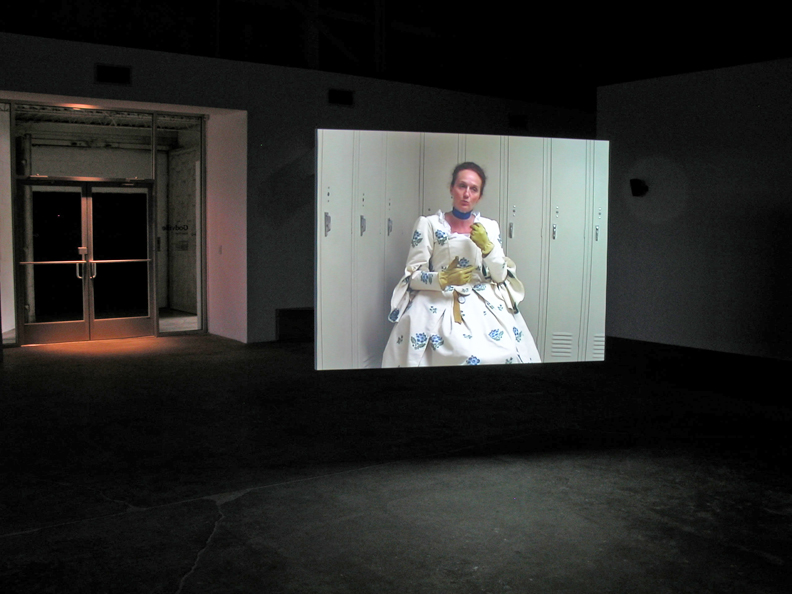
In Godville (2005), a 51-minute, two-channel color video, historical reenactors at the Colonial Williamsburg living-history museum in Virginia describe their eighteenth-century characters’ lives and their personal lives in ways that seem interchangeable. Fast splices the reenacted and real biographies together, often word-byword, into a rambling narrative that is as aurally fluent as it is temporally dissonant. The work tells the story of a town in America whose residents are unmoored, floating somewhere between the past and the present, between revolution and reenactment, between fiction and life.
Fast’s recent work The Casting (2007), a shorter four-channel video projection, addresses current events. A U.S. Army sergeant recounts two incidents: a romantic liaison with a young German woman who mutilates herself and the accidental shooting of an Iraqi. The two tales are seamlessly woven together into a script that was given to actors to perform in silent tableaux. While the actors try hard to keep still, the narrator’s recollections slip between setting and story, trying to find relief if not redemption in the act of recalling. JASON EDWARD KAUFMAN


